Table of Contents
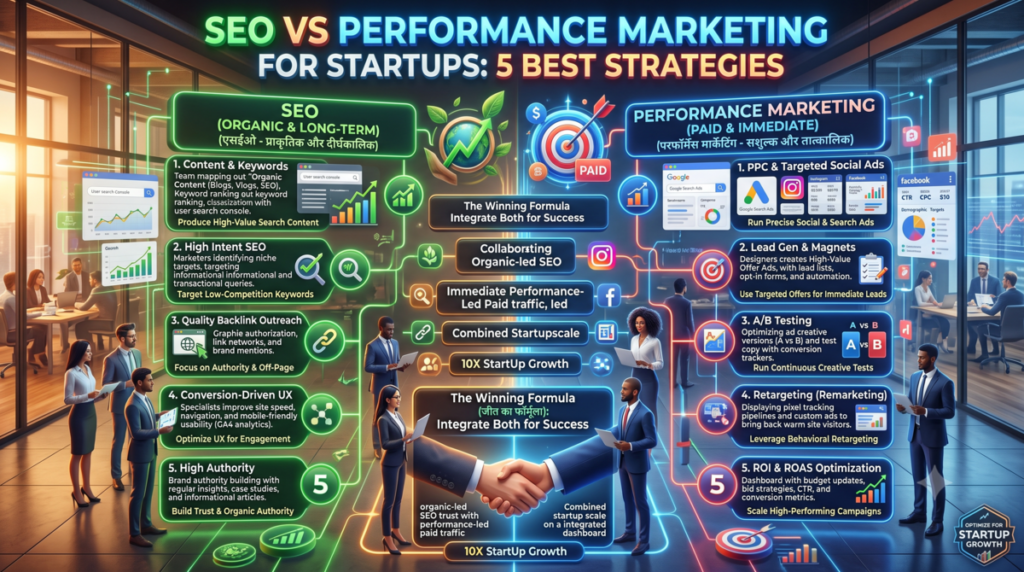
Every founder faces the critical challenge of customer acquisition with limited capital and tight deadlines. When scaling an early-stage business, the central question always boils down to one fundamental debate: SEO vs Performance Marketing for Startups. Should you invest your capital into immediate paid traffic through Google and Meta Ads, or should you build a long-term organic foundation through search engine optimization?
Choosing the wrong channel at the wrong time can burn through your financial runway without generating meaningful revenue. In this comprehensive guide, we will break down the mechanics, cost structures, timelines, and hybrid strategies behind SEO vs Performance Marketing for Startups to help you make an informed decision for your first six months of operation.
Understanding the Fundamentals: Organic Search vs Paid Growth
To establish a clear marketing direction, you must first understand how each channel operates within a startup sales funnel. When analyzing SEO vs Performance Marketing for Startups, identifying where your target market spends their attention is your foundational priority.
What is Search Engine Optimization (SEO)?
Search Engine Optimization is the process of improving your website to increase visibility on search engines like Google when people search for products or services related to your business. SEO relies heavily on three core pillars:
- Technical SEO: Ensuring site architecture, mobile responsiveness, fast loading speeds, and crawlability.
- On-Page SEO: Crafting high-quality content targeting specific search intent, utilizing strategic headings, internal links, and keyword optimization.
- Off-Page SEO: Earning high-authority backlinks and digital PR mentions that build brand trustworthiness and domain rating.
What is Performance Marketing?
Performance marketing is a comprehensive term for online marketing and advertising programs where buyers pay marketing companies or advertising platforms when specific actions are completed—such as a click, lead form submission, app install, or sale. The dominant channels include:
- Google Search & Shopping Ads: Targeting users showing high commercial intent at the exact moment of search.
- Meta Ads (Facebook & Instagram): Generating brand discovery and interest through advanced visual creative and audience profiling.SEO vs Performance Marketing for Startups.
- LinkedIn & TikTok Ads: Niche audience targeting for B2B decision-makers or direct-to-consumer lifestyle brands.
When founders assess SEO vs Performance Marketing for Startups, knowing whether the market already searches for their solution determines their immediate tactical priorities.
SEO vs Performance Marketing for Startups: A Deep Comparative Breakdown
Evaluating both channels across critical business metrics clarifies their strategic value.
| Growth Metric | Search Engine Optimization (SEO) | Performance Marketing (Paid Ads) |
| Time to First Result | 3 to 6 months minimum | 24 to 48 hours |
| Initial Capital Requirement | High upfront time or agency fees | Immediate ad spend budget required |
| Traffic Scalability | Compounds organically over time | Linear (scales as long as budget increases) |
| Traffic Sustainability | Sustains even if you pause spending | Stops instantly when ad spend stops |
| Primary Risk Factor | Algorithm updates & slow traction | High Ad Fatigue, low conversion, ad spend loss |
| Conversion Intent | High on informational/commercial queries | Highly targeted based on campaign objective |
This direct comparison highlights why founders must carefully analyze SEO vs Performance Marketing for Startups before deploying precious resources.
The Advantages and Bottlenecks of SEO for Startups
Search engine optimization is often viewed as “free traffic,” but it represents an active investment of time, resources, and technical refinement.
Key Advantages of SEO
- Compounding Long-Term Asset: Unlike an ad campaign that disappears once the daily budget depletes, an optimized article continues bringing qualified visitors for years.
- Reduced Customer Acquisition Cost (CAC): Over an 18-month horizon, your effective cost per acquired customer drops significantly because organic clicks carry no marginal cost.
- High Buyer Trust: Many searchers instinctively scroll past sponsored links to click organic results, viewing top-ranked sites as industry authorities.
- Sustainable Pipeline: Unlike paid traffic channels, mastering SEO vs Performance Marketing for Startups ensures you build an enduring pipeline of qualified buyers without relying entirely on monthly ad spend.
Critical Challenges for Early-Stage Startups
- Delayed Feedback Loop: It is difficult to validate whether your target audience actually wants your value proposition if you must wait four months to get consistent organic traffic.
- Competitive Moats: Competing against established industry leaders with thousands of referring domains requires patience and substantial content output.
Understanding these trade-offs is essential when navigating SEO vs Performance Marketing for Startups in competitive markets.
The Power and Perils of Performance Marketing

Performance advertising provides speed, immediate quantitative feedback, and laser-targeted audience reach.
Key Advantages of Performance Marketing
- Immediate Market Validation: You can set up a landing page, run targeted ads, and know within 72 hours whether your copy, pricing, and product solve an urgent problem.
- Precise Funnel Control: You control the audience demographics, geographical boundaries, search intent keywords, and exact budget caps.
- Predictable Scaling: If you invest a set budget and consistently generate positive return on ad spend (ROAS), you can scale your customer acquisition pipeline predictably.
Common Pitfalls for New Businesses
- Rising Cost-Per-Click (CPC): Ad auction competition intensifies continuously, making budget bleed common for founders without deep ad-management experience.
- Ad Fatigue & Plateauing: Ad creatives degrade in performance quickly. Teams must constantly design new hooks, angles, and visual assets to maintain performance.
Mastering both channels requires real-world practical training. Leading regional training centers like dizital Mantras specialize in bridging this exact knowledge gap, training young marketers and startup teams on how to manage live ad spend alongside technical organic optimization.SEO vs Performance Marketing for Startups.
5 Best Strategies to Balance SEO and Performance Marketing
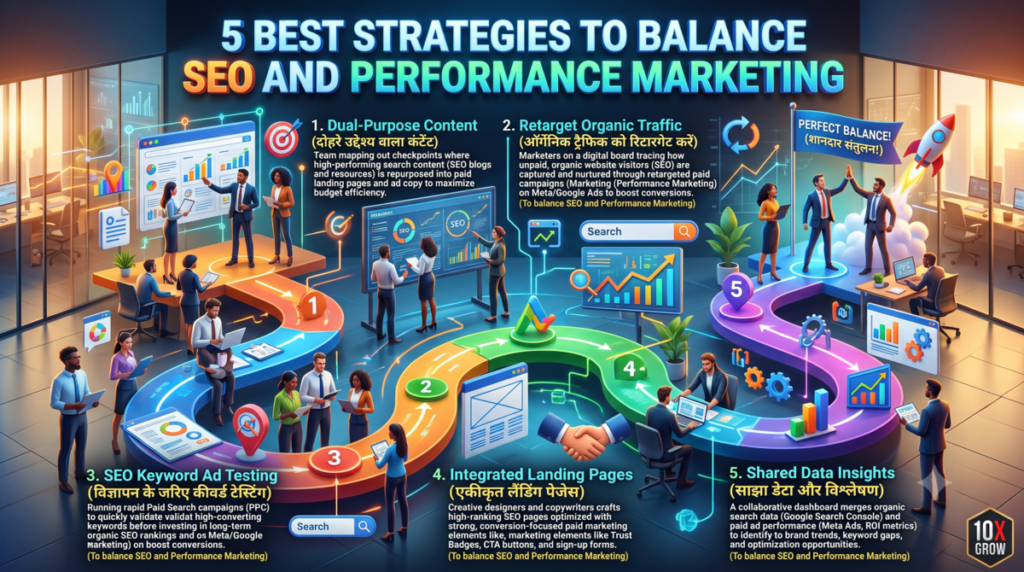
When evaluating SEO vs Performance Marketing for Startups, the winning decision is rarely an “either/or” choice. The most successful founders implement an integrated growth roadmap tailored to their business lifecycle.
1. The Validation-First Framework (Months 1–2)
Do not spend months writing dozens of blog posts before validating whether your offer converts.
- Allocate the majority of your initial budget to performance marketing. Run targeted Google Search ads on high-intent transactional queries.
- Analyze your landing page bounce rates, heatmaps, and form-fill percentages.
- Once your landing page achieves a stable conversion baseline, you have concrete data on which exact keywords produce paying customers.
2. The Keyword Reverse-Engineering Method
One of the smartest applications of SEO vs Performance Marketing for Startups involves data mining your search ads.
- Look at the exact search queries inside your advertising dashboard that resulted in conversions at the lowest cost per acquisition.
- Feed those high-converting queries directly into your content calendar as primary keywords for your long-form WordPress articles.
- You eliminate the guesswork of SEO by writing content exclusively around keywords already proven to generate revenue.
3. The 70/30 Budget Allocation Model (Months 3–4)
Once basic product-market fit is established:
- Shift to a 70/30 split: 70% of resources maintain active paid acquisition to protect immediate cash flow, while 30% goes toward technical SEO, site speed, and Rank Math-optimized content production.
- Begin building content clusters: write one pillar page targeting your primary solution, supported by multiple targeted cluster blogs answering long-tail customer questions.
4. Retargeting Organic Traffic with Paid Ads
Organic traffic alone rarely converts on the very first touchpoint. A visitor may read your blog post, find value, and leave without subscribing or purchasing.
- Install tracking pixels and remarketing tags across your WordPress site.
- Build low-cost retargeting campaigns that serve targeted case studies or limited-time promotional offers strictly to visitors who browsed your high-intent SEO pages.
- This dramatically lowers your overall paid acquisition cost because you are marketing to a warm, qualified audience.
5. Transitioning to Organic Dominance (Months 5–6 and Beyond)
As your website builds domain authority and your cluster articles climb to Page 1 of Google:
- Your inbound organic lead volume begins offsetting paid advertising requirements.
- You can trim underperforming broad ad campaigns and concentrate your paid budget strictly on your highest-margin products.
- At this stage, SEO acts as your sustainable base engine, while performance marketing serves as an accelerator for new product launches or seasonal promotions.
This structured progression illustrates how SEO vs Performance Marketing for Startups evolves from paid dependence into organic asset ownership.
Strategic Decision Matrix: Which Should You Prioritize Today?

If your startup must choose only one dominant channel due to extreme budget limitations, use these concrete operating criteria:
Choose Performance Marketing First If:
- You have less than 90 days of operational cash runway.
- You need to validate product pricing, customer willingness to pay, and target messaging immediately.
- You are operating an e-commerce brand or localized direct-response business requiring immediate transaction volume.
Choose SEO First If:
- You are in a niche with massive search volume but low domain competition.
- Your product requires deep consumer education (e.g., specialized B2B software, technical consulting).
- Ad platform restrictions or high cost-per-click rates make paid advertising financially unviable in your sector.
Understanding the tactical balance in SEO vs Performance Marketing for Startups ensures you do not waste resources pursuing vanity metrics.SEO vs Performance Marketing for Startups.
Technical On-Page SEO Checklist for Your Content Strategy
To ensure your articles achieve maximum visibility on search engines, apply this structured on-page protocol:
- Target Intent Alignment: Match whether users want quick definitions, step-by-step guides, or commercial comparisons.
- Semantic Heading Hierarchy: Maintain a clean structure using a single H1, logical H2 sections for major themes, and H3 tags for granular breakdowns.
- Internal Architecture: Link your informational blog posts directly to your commercial service or product checkout pages with contextual anchor text.
- Technical Performance: Optimize image file sizes, implement clean schema markup, and ensure lightning-fast page loading speeds on mobile devices.
Institutes with hands-on curriculums like dizital Mantras emphasize these exact technical foundations, showing students how on-page optimization integrates directly with campaign funnels.
Frequently Asked Questions (FAQ)
1. Which delivers a better ROI: SEO or Performance Marketing?
In the first 3 months of assessing SEO vs Performance Marketing for Startups, performance marketing delivers a faster return on investment (ROI) because campaigns can generate conversions immediately. However, over a 12 to 24-month horizon, SEO typically delivers a significantly higher cumulative ROI because organic search traffic continues to arrive without ongoing per-click advertising costs.
2. Can an early-stage startup survive using only SEO?
Relying exclusively on SEO in the first 90 days is risky for startups operating with a limited financial runway. In the core context of SEO vs Performance Marketing for Startups, search indexing and algorithmic ranking require time to mature, making a hybrid execution much safer for initial cash flow.
3. How much should a new business spend on SEO vs Performance Marketing for Startups?
A balanced rule of thumb for early-stage companies is an 80/20 or 70/30 split. Dedicate 70% to 80% of your initial marketing budget to paid performance channels to validate product-market fit and generate immediate leads. Allocate the remaining 20% to 30% toward technical site optimization, content creation, and search engine groundwork.
4. How can startups use paid search data to improve their SEO strategy?
Run targeted Google Search campaigns to discover which high-intent search queries trigger the highest conversion rates and form fills. Once you identify these proven commercial terms, integrate them as target focus keywords for your long-form pillar articles on WordPress. This framework removes guesswork when analyzing SEO vs Performance Marketing for Startups.
5. When is the right time to shift budget from paid ads to organic content?
The best time to reallocate budget toward organic optimization is once your conversion funnel is proven and your customer acquisition cost on paid platforms begins to stabilize or rise due to ad fatigue. Reinvesting paid profits into high-ranking content assets creates a reliable stream of inbound organic leads that permanently lowers your overall marketing spend.
Conclusion and Strategic Takeaway
The debate surrounding SEO vs Performance Marketing for Startups is not a battle of opposing philosophies. Instead, they are two stages of a unified marketing ecosystem. Performance marketing delivers immediate validation, speed, and real-time behavioral data, while SEO constructs an enduring, high-equity brand foundation that permanently lowers customer acquisition costs over time.
By utilizing performance marketing to validate your value proposition in months one and two, then methodically reinvesting those learnings into a robust SEO content engine, your startup can achieve both short-term cash flow and sustainable, long-term market dominance. Institutions like dizital Mantras continue to prove that marketers who master both disciplines become indispensable growth drivers. Evaluating the balance between SEO vs Performance Marketing for Startups helps you allocate your capital intelligently, identify realistic revenue goals, and build an integrated strategy that maximizes your return on investment today.

Leave a Reply